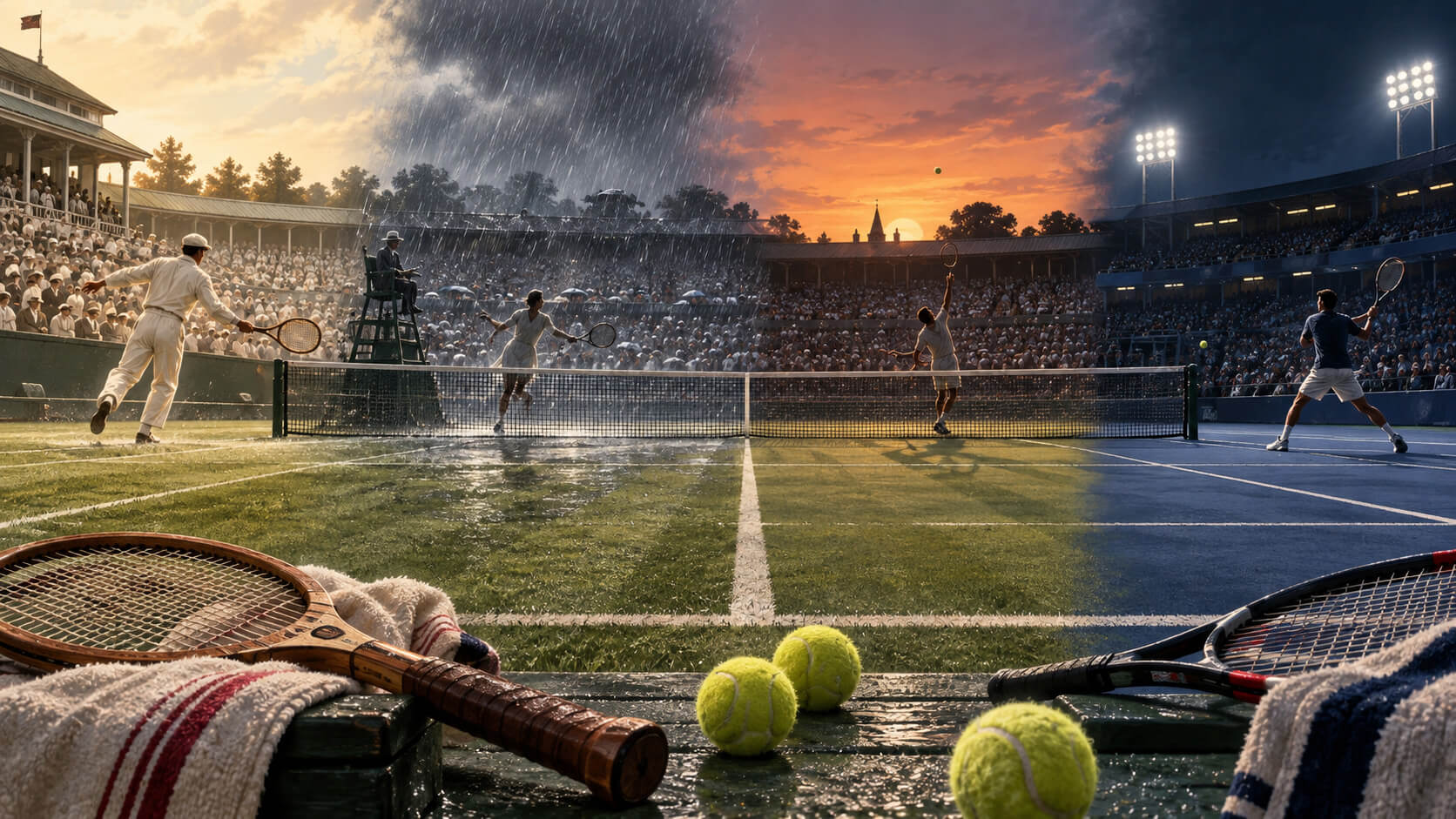
Tennis history is full of matches people remember point by point. Some changed a rivalry. Others marked a comeback or pushed two players far beyond what seemed possible. Those stories are part of what makes tennis memorabilia meaningful.
A signature on a tennis ball, card, hat, or racket carries more context when you know what the player accomplished. These four finals gave tennis fans moments that are still discussed decades later.
Roger Federer vs. Rafael Nadal, 2008 Wimbledon Final
Roger Federer arrived at the 2008 Wimbledon final as the five-time defending champion. He had beaten Rafael Nadal in the previous two finals and had not lost a match at Wimbledon since 2002. Nadal had dominated their meetings on clay, but beating Federer on Centre Court was a different challenge.
Nadal won the first two sets before Federer fought back by taking two consecutive tiebreaks. Rain interrupted the match, daylight began to disappear, and the final moved into a fifth set with neither player giving much away.
After four hours and 48 minutes, Nadal won 6-4, 6-4, 6-7, 6-7, 9-7. It was his first Wimbledon title and the end of Federer’s five-year run as champion. The fading light, the rain delays, and the contrast between the two players made it feel bigger than a normal championship match.
For collectors, the match gives added meaning to memorabilia connected to either player. Federer and Nadal are remembered individually, but pieces associated with their rivalry tell a larger story about one of tennis’s defining eras.
Venus Williams vs. Lindsay Davenport, 2005 Wimbledon Final
Venus Williams entered Wimbledon in 2005 as the No. 14 seed. She had not won a major singles title since 2001, and few expected her to make a deep run. That changed when she defeated defending champion Maria Sharapova in the semifinal.
World No. 1 Lindsay Davenport stood between Williams and another Wimbledon title. Davenport won the first set and later held a championship point in the third. Williams saved it, stayed in the match, and eventually won 4-6, 7-6, 9-7.
The final lasted two hours and 45 minutes, making it the longest Wimbledon women’s singles final at the time. Williams had entered the tournament outside the group of expected champions and left with her third Wimbledon singles title.
This match is remembered for more than its length. It showed how quickly expectations can change when a proven champion finds her game again.
Bjorn Borg vs. John McEnroe, 1980 Wimbledon Final
Bjorn Borg and John McEnroe brought very different personalities to Centre Court in 1980. Borg was the calm four-time defending champion. McEnroe was 21 years old, unpredictable, and playing in his first Wimbledon singles final.
McEnroe took the opening set, but Borg won the next two. The fourth-set tiebreak then became the part everyone remembered. It lasted 22 minutes and covered 34 points, with McEnroe saving multiple championship points before winning it 18-16.
Borg recovered in the fifth set and won the match 1-6, 7-5, 6-3, 6-7, 8-6. The victory gave him a fifth consecutive Wimbledon singles championship.
The match helped define both players. Their contrasting styles and temperaments turned an already important final into one of the best-known rivalries in tennis.
Monica Seles vs. Steffi Graf, 1995 US Open Final
Monica Seles missed more than two years of competition after being attacked during a match in Hamburg in 1993. She returned to the tour in the summer of 1995 and won her comeback event in Canada without dropping a set.
The US Open was her first major tournament after returning. Seles advanced all the way to the final, where she faced Steffi Graf. Their rivalry had helped shape women’s tennis before Seles was forced away from the sport.
Graf narrowly won the opening set in a tiebreak. Seles answered with a 6-0 second set, but Graf recovered and took the deciding set 6-3. The result gave Graf the championship, while Seles’s run to the final completed one of the sport’s most closely watched comebacks.
Memorabilia connected to either player carries the history of that rivalry, but this match also represents persistence. Seles returned after an experience that could easily have ended her career and immediately competed for one of tennis’s biggest titles.
What These Matches Add to a Collection
A signed collectible does not have to come from a particular match to carry meaning. You might collect a player because you watched that final, followed the rivalry, or remember where you were when the last point was played.
The current selection of signed tennis memorabilia may include autographed tennis balls, cards, hats, rackets, and other collectibles. Inventory changes as individual pieces sell, so each listing should be checked for the signer, condition, dimensions, authentication, and everything included.
It is also important to separate an autograph from an item’s history. A tournament-branded tennis ball is not automatically match-used. A signed racket is not automatically the player’s personal racket. Match use, tournament use, and player ownership require separate documentation.
What to Check Before Buying Tennis Memorabilia
- Confirm who signed the item and where the autograph appears.
- Review the item’s condition and dimensions.
- Check which Certificate of Authenticity or third-party documentation is included.
- Match any certification number to the information in the listing.
- Look for separate provenance when an item is described as player-owned or match-used.
- Confirm whether a case, stand, or other display accessory is included.
Every signed item offered by Autographia is examined before it is listed. Each piece comes with an Autographia Certificate of Authenticity and matching numbered, tamper-proof holograms. Some items also include independent authentication, which is identified on the product page.
Learn more about how autograph authentication works or use the hologram verification page to check an Autographia hologram number.
Tennis Memorabilia FAQ
What is considered tennis memorabilia?
Tennis memorabilia can include signed tennis balls, rackets, cards, hats, programs, tickets, and other items connected to players, tournaments, or important moments in the sport. Check the individual listing to understand exactly what is being offered.
Does an authentic autograph mean the item was used in a match?
No. Autograph authentication addresses the signature. It does not prove that the underlying item was owned or used by the player. Match-used and player-owned claims need separate provenance.
How can I tell if signed tennis memorabilia is authentic?
Review the Certificate of Authenticity, hologram number, and any independent authentication identified in the listing. The product page should clearly explain which documentation comes with the item.
What types of signed tennis collectibles does Autographia carry?
Depending on current inventory, you may find signed tennis balls, cards, hats, rackets, and other collectibles from well-known players. Browse the tennis memorabilia collection to see what is currently available.
 (813) 563-7540
 Login
Login



 Trustpilot